Nitromide (CED0035859)

Record Information
Version1.0
Creation Date2016-05-22 05:21:55 UTC
Update Date2026-08-24 03:27:39 UTC
SynCED IDCED0035859
Secondary Accession Numbers
  • CHEM018587
Identification
Common NameNitromide
ClassSmall Molecule
Description
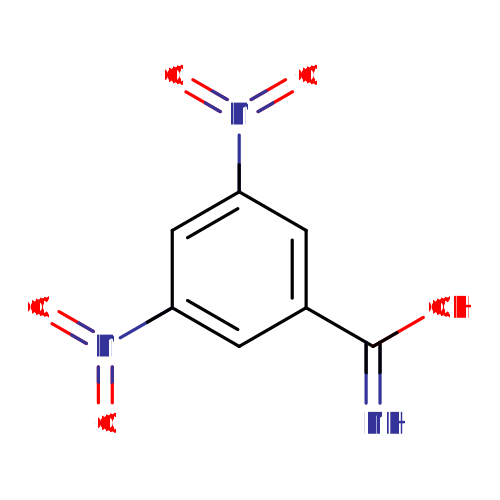
Nitromide is an organic compound with the chemical formula C7H5N3O5 and an average molecular weight of 211.13 g/mol. Nitromide belongs to the nitrobenzenes, a subclass of benzene and substituted derivatives within the organic compounds. This compound is associated with four recorded sources of occurrence or release. These include electrical and electronic equipment, specifically amplifiers and electrodes, as well as food preservation within food, food processing, and cookware. Additionally, it is found in household cleaning and consumer products, specifically tobacco smoke filters.
Contaminant TypeNot Available
Chemical Structure
Synonyms
ValueSource
3,5-Dinitrobenzene-1-carboximidateHMDB
UnistatHMDB
NitromideHMDB
Chemical FormulaC7H5N3O5
Average Molecular Mass211.133 g/mol
Monoisotopic Mass211.023 g/mol
CAS Registry Number121-81-3
IUPAC Name3,5-dinitrobenzene-1-carboximidic acid
Traditional Nameunistat
SMILESOC(=N)C1=CC(=CC(=C1)N(=O)=O)N(=O)=O
InChI IdentifierInChI=1S/C7H5N3O5/c8-7(11)4-1-5(9(12)13)3-6(2-4)10(14)15/h1-3H,(H2,8,11)
InChI KeyUUKWKUSGGZNXGA-UHFFFAOYSA-N
Chemical Taxonomy
Description Belongs to the class of organic compounds known as nitrobenzenes. Nitrobenzenes are compounds containing a nitrobenzene moiety, which consists of a benzene ring with a carbon bearing a nitro group.
KingdomOrganic compounds
Super ClassBenzenoids
ClassBenzene and substituted derivatives
Sub ClassNitrobenzenes
Direct ParentNitrobenzenes
Alternative Parents
Substituents
  • Benzamide
  • Benzoic acid or derivatives
  • Nitrobenzene
  • Nitroaromatic compound
  • Benzoyl
  • Carboxamide group
  • C-nitro compound
  • Primary carboxylic acid amide
  • Organic nitro compound
  • Allyl-type 1,3-dipolar organic compound
  • Organic oxoazanium
  • Carboxylic acid derivative
  • Propargyl-type 1,3-dipolar organic compound
  • Organic 1,3-dipolar compound
  • Organic zwitterion
  • Organic oxygen compound
  • Organooxygen compound
  • Organonitrogen compound
  • Organic oxide
  • Organic nitrogen compound
  • Organopnictogen compound
  • Hydrocarbon derivative
  • Aromatic homomonocyclic compound
Molecular FrameworkAromatic homomonocyclic compounds
External DescriptorsNot Available
Biological Properties
StatusDetected and Not Quantified
OriginNot Available
Cellular LocationsNot Available
Biofluid LocationsNot Available
Tissue LocationsNot Available
ApplicationsNot Available
Biological RolesNot Available
Chemical RolesNot Available
Organoleptic EffectsNot Available
Physical Properties
StateNot Available
AppearanceNot Available
Experimental Properties
PropertyValue
Melting PointNot Available
Boiling PointNot Available
SolubilityNot Available
Predicted Properties
PropertyValueSource
Water Solubility0.098 g/LALOGPS
logP0.58ALOGPS
logP1.14ChemAxon
logS-3.3ALOGPS
pKa (Strongest Acidic)5.96ChemAxon
pKa (Strongest Basic)4.34ChemAxon
Physiological Charge0ChemAxon
Hydrogen Acceptor Count6ChemAxon
Hydrogen Donor Count2ChemAxon
Polar Surface Area135.72 ŲChemAxon
Rotatable Bond Count3ChemAxon
Refractivity60.72 m³·mol⁻¹ChemAxon
Polarizability17.36 ųChemAxon
Number of Rings1ChemAxon
BioavailabilityYesChemAxon
Rule of FiveYesChemAxon
Ghose FilterYesChemAxon
Veber's RuleNoChemAxon
MDDR-like RuleNoChemAxon
Spectra
Spectra
Spectrum TypeDescriptionSplash KeyDeposition DateView
Predicted GC-MSPredicted GC-MS Spectrumsplash10-03di-6290000000-d490c48149605ecbdf76Not AvailableView Spectrum
Predicted GC-MSPredicted GC-MS SpectrumNot AvailableNot AvailableView Spectrum
LC-MS/MSLC-MS/MS Spectrumsplash10-00dj-1910000000-27908f9670549cabfb5cNot AvailableView Spectrum
Predicted LC-MS/MSPredicted LC-MS/MS Spectrumsplash10-03di-0090000000-4f1676ba05454cd7e29fNot AvailableView Spectrum
Predicted LC-MS/MSPredicted LC-MS/MS Spectrumsplash10-0a4r-0890000000-1d6e75251c212fc04086Not AvailableView Spectrum
Predicted LC-MS/MSPredicted LC-MS/MS Spectrumsplash10-0019-2920000000-f828ba7b760777d05234Not AvailableView Spectrum
Predicted LC-MS/MSPredicted LC-MS/MS Spectrumsplash10-03di-0090000000-0c40e060c20ee8e06033Not AvailableView Spectrum
Predicted LC-MS/MSPredicted LC-MS/MS Spectrumsplash10-03di-0090000000-47d74c5cb33322ecc06eNot AvailableView Spectrum
Predicted LC-MS/MSPredicted LC-MS/MS Spectrumsplash10-01ox-9220000000-f676ffbc72acbc9f7929Not AvailableView Spectrum
Toxicity Profile
Toxicity Values
Toxicity ValueOrganismDose DescriptorRoute of ExposurePredicted or ExperimentalToxicity RatingReference
123.0 Log mg/kg [70:220]RatLD50oralpredictedNot AvailableNot Available
Toxicity / Toxin ClassNot Available
Mechanism of ToxicityNot Available
Carcinogenicity (IARC Classification)Not Available
Minimum Risk LevelNot Available
SymptomsNot Available
TreatmentNot Available
Health Effects
Health EffectRelationshipDirectionDescriptionReference
Exposure Sources
Source IDSourceSectorReference
CEDs000505Amplifiers?Amplifiers, commonly used in various electronic devices to enhance signal strength, can be a source of synthetic chemical contamination due to the materials and processes involved in their production and disposal.Electrical & Electronic EquipmentPubChem
CEDs000519Electrodes?Electrodes, used in various electrical and electronic applications, can be a source of synthetic chemical contamination due to the materials from which they are constructed and the processes involved in their manufacturing.Electrical & Electronic EquipmentPubChem
CEDs000545Food Preservation?Food preservation often involves the use of synthetic chemicals, such as preservatives, flavor enhancers, and color additives, to extend shelf life and enhance the sensory qualities of food products.Food, food processing & cookwarePubChem
CEDs000569Tobacco Smoke Filters?Tobacco smoke filters are designed to reduce the inhalation of harmful substances in cigarette smoke, including tar and other particulate matter.Household cleaning & consumer productsPubChem
CEDs000580Manufacture Preparation Of Tobacco Products?The manufacture and preparation of tobacco products involve various processes that can result in the introduction of synthetic chemicals into the environment.Industrial manufacturing & chemical processingPubChem
CEDs000583Anchoring Equipment?Anchoring equipment, commonly used in marine applications, can be a source of synthetic chemical contamination due to the materials and coatings utilized in their manufacturing.Marine, shipping & aquaculturePubChem
CEDs000609Aftershave?Aftershave is a grooming product typically used to soothe and protect the skin following shaving.Personal care & cosmeticsPubChem
CEDs000610Aftersun Products?Aftersun products are designed to soothe and hydrate the skin after sun exposure, often containing various synthetic chemicals such as emollients, preservatives, and fragrances.Personal care & cosmeticsPubChem
CEDs000611Anti Perspirants Or Body Deoderants?Antiperspirants and body deodorants commonly contain synthetic chemicals such as aluminum compounds, parabens, and synthetic fragrances.Personal care & cosmeticsPubChem
CEDs000614Essential Oils Or Perfumes?Essential oils and perfumes are complex mixtures of volatile compounds derived from natural or synthetic sources, commonly used for their aromatic properties.Personal care & cosmeticsPubChem
CEDs000616Face Mask Cosmetics?Face mask cosmetics often contain a variety of synthetic chemicals, including preservatives, emulsifiers, and fragrances, which can contribute to chemical contamination.Personal care & cosmeticsPubChem
CEDs000617Lip Care Products?Lip care products, including lipsticks, balms, and glosses, often contain a variety of synthetic chemicals such as parabens, phthalates, and synthetic fragrances.Personal care & cosmeticsPubChem
CEDs000618Lip Makeup Products?Lip makeup products, such as lipsticks, lip glosses, and lip liners, often contain a variety of synthetic chemicals, including pigments, preservatives, and emollients.Personal care & cosmeticsPubChem
CEDs000632Apparel?Apparel production often involves the use of various synthetic chemicals, including dyes, finishing agents, and preservatives.Textiles, leather & furnishingsPubChem
CEDs000642Footwear?Footwear production often involves the use of various synthetic chemicals, such as adhesives, dyes, and treatments, which can contribute to environmental contamination.Textiles, leather & furnishingsPubChem
CEDs000684Cements?Cements are a composite material primarily used as a binding agent in construction applications, formed by the calcination of limestone and clay minerals at high temperatures.Building & ConstructionPubChem
CEDs000696Nanotechnology?Nanotechnology involves the manipulation of materials at the molecular or atomic level, typically within the range of 1 to 100 nanometers.Industrial manufacturing & chemical processingPubChem
CEDs000735Explosives?Explosives are chemical compounds or mixtures designed to undergo rapid decomposition, releasing energy in the form of gas and heat.Defense & military infrastructurePubChem
CEDs000739Inks?Inks are complex mixtures composed of pigments or dyes, solvents, resins, and additives used primarily for printing and writing applications.Paper, pulp & fiber productsPubChem
CEDs000740Paper?Paper production involves the processing of wood fibers and the use of various chemicals, which can lead to synthetic chemical contamination.Paper, pulp & fiber productsPubChem
CEDs000744Water, Wastewater, & Sewage Treatment?Water, wastewater, and sewage treatment processes are critical for managing and mitigating pollutants in water systems.Wastewater, sanitation & biosolidsPubChem
CEDs01391Poultry DietsFood, food processing & cookwarePMC6801513
Pathways
0 pathwaysPathway Source: PathBank

No pathways found

No metabolic pathways have been associated with this synthetic chemical

Targets
StructureProteinUniProt IDOrganismRelationshipDetails
Endolysin structureClick to view 3D structureEndolysinP00720Enterobacteria phage T4Predicted (SEA)
Prediction Confidence Score
0.379
Applicability Domain
0.379
Statistical Significance
1.10e-04
Supporting Reference Compounds
1
E-value
0.856341
Thioredoxin reductase structureClick to view 3D structureThioredoxin reductaseP61076Plasmodium falciparum 3D7Predicted (SEA)
Prediction Confidence Score
0.316
Applicability Domain
0.316
Statistical Significance
6.00e-05
Supporting Reference Compounds
1
E-value
0.467095
Click to view 3D structureATP-dependent molecular chaperone HSP82C4YTQ8Candida albicans (strain WO-1) (Yeast)Predicted (SEA)
Prediction Confidence Score
0.284
Applicability Domain
0.325
Statistical Significance
0.0156
Supporting Reference Compounds
205
E-value
121.445
Carbonic anhydrase 2 structureClick to view 3D structureCarbonic anhydrase 2P00918HumansPredicted (SEA)
Prediction Confidence Score
0.284
Applicability Domain
0.306
Statistical Significance
0.0689
Supporting Reference Compounds
472
E-value
536.148
Catechol O-methyltransferase structureClick to view 3D structureCatechol O-methyltransferaseP22734Rattus norvegicusPredicted (SEA)
Prediction Confidence Score
0.28
Applicability Domain
0.406
Statistical Significance
0.0012
Supporting Reference Compounds
15
E-value
9.57545
Arylsulfatase structureClick to view 3D structureArylsulfataseP51691Pseudomonas aeruginosa (strain ATCC 15692 / PAO1 / 1C / PRS 101 / LMG 12228)Predicted (SEA)
Prediction Confidence Score
0.275
Applicability Domain
0.275 Low confidence
Statistical Significance
0.0017
Supporting Reference Compounds
1
E-value
13.4679
Carbonic anhydrase 1 structureClick to view 3D structureCarbonic anhydrase 1P00915HumansPredicted (SEA)
Prediction Confidence Score
0.268
Applicability Domain
0.306
Statistical Significance
0.0841
Supporting Reference Compounds
407
E-value
654.868
Click to view 3D structureStreptokinase AP10520Streptococcus pyogenes serotype M1Predicted (SEA)
Prediction Confidence Score
0.267
Applicability Domain
0.295 Low confidence
Statistical Significance
0.072
Supporting Reference Compounds
425
E-value
560.748
Fatty acid synthase structureClick to view 3D structureFatty acid synthaseP49327HumansPredicted (SEA)
Prediction Confidence Score
0.266
Applicability Domain
0.28 Low confidence
Statistical Significance
0.0197
Supporting Reference Compounds
117
E-value
153.285
Click to view 3D structurePutative nitroreductaseQ4A0P1Staphylococcus saprophyticus subsp. saprophyticus (strain ATCC 15305 / DSM20229 / NCIMB 8711 / NCTC 7292 / S-41)Predicted (SEA)
Prediction Confidence Score
0.261
Applicability Domain
0.289 Low confidence
Statistical Significance
6.20e-04
Supporting Reference Compounds
2
E-value
4.82665
Prostaglandin G/H synthase 2 structureClick to view 3D structureProstaglandin G/H synthase 2P35354HumansPredicted (SEA)
Prediction Confidence Score
0.258
Applicability Domain
0.341
Statistical Significance
0.0646
Supporting Reference Compounds
201
E-value
503.14
Caspase-3 structureClick to view 3D structureCaspase-3P42574HumansPredicted (SEA)
Prediction Confidence Score
0.257
Applicability Domain
0.282 Low confidence
Statistical Significance
0.0471
Supporting Reference Compounds
125
E-value
366.436
Transthyretin structureClick to view 3D structureTransthyretinP02766HumansPredicted (SEA)
Prediction Confidence Score
0.254
Applicability Domain
0.406
Statistical Significance
0.0123
Supporting Reference Compounds
55
E-value
95.521
Aldo-keto reductase family 1 member C3 structureClick to view 3D structureAldo-keto reductase family 1 member C3P42330HumansPredicted (SEA)
Prediction Confidence Score
0.251
Applicability Domain
0.341
Statistical Significance
0.0348
Supporting Reference Compounds
57
E-value
270.837
Aldo-keto reductase family 1 member C2 structureClick to view 3D structureAldo-keto reductase family 1 member C2P52895HumansPredicted (SEA)
Prediction Confidence Score
0.249
Applicability Domain
0.341
Statistical Significance
0.0299
Supporting Reference Compounds
40
E-value
233.081
Click to view 3D structureCatechol O-methyltransferaseQ99028Sus scrofaPredicted (SEA)
Prediction Confidence Score
0.247
Applicability Domain
0.263 Low confidence
Statistical Significance
7.50e-04
Supporting Reference Compounds
2
E-value
5.83869
Protein RecA structureClick to view 3D structureProtein RecAP9WHJ3Mycobacterium tuberculosisPredicted (SEA)
Prediction Confidence Score
0.247
Applicability Domain
0.325
Statistical Significance
0.1137
Supporting Reference Compounds
296
E-value
884.834
Click to view 3D structureHeat shock factor protein 1P38532Mus musculusPredicted (SEA)
Prediction Confidence Score
0.246
Applicability Domain
0.333
Statistical Significance
0.0835
Supporting Reference Compounds
166
E-value
650.43
Click to view 3D structureNitric oxide synthase 3P70313Mus musculusPredicted (SEA)
Prediction Confidence Score
0.245
Applicability Domain
0.245 Low confidence
Statistical Significance
0.0035
Supporting Reference Compounds
1
E-value
27.3251
Dual specificity protein phosphatase 3 structureClick to view 3D structureDual specificity protein phosphatase 3P51452HumansPredicted (SEA)
Prediction Confidence Score
0.242
Applicability Domain
0.302
Statistical Significance
0.0534
Supporting Reference Compounds
147
E-value
415.715
Serine/threonine-protein kinase Chk1 structureClick to view 3D structureSerine/threonine-protein kinase Chk1O14757HumansPredicted (SEA)
Prediction Confidence Score
0.242
Applicability Domain
0.308
Statistical Significance
0.4017
Supporting Reference Compounds
807
E-value
3127.51
Tyrosine-protein phosphatase non-receptor type 11 structureClick to view 3D structureTyrosine-protein phosphatase non-receptor type 11Q06124HumansPredicted (SEA)
Prediction Confidence Score
0.242
Applicability Domain
0.302
Statistical Significance
0.0481
Supporting Reference Compounds
109
E-value
374.766
Genome polyprotein structureClick to view 3D structureGenome polyproteinP29990dengue virus type 2Predicted (SEA)
Prediction Confidence Score
0.242
Applicability Domain
0.286 Low confidence
Statistical Significance
0.0339
Supporting Reference Compounds
58
E-value
263.909
Protein max structureClick to view 3D structureProtein maxP61244HumansPredicted (SEA)
Prediction Confidence Score
0.241
Applicability Domain
0.241 Low confidence
Statistical Significance
0.0029
Supporting Reference Compounds
1
E-value
22.2649
NH(3)-dependent NAD(+) synthetase structureClick to view 3D structureNH(3)-dependent NAD(+) synthetaseQ81RP3Bacillus anthracisPredicted (SEA)
Prediction Confidence Score
0.24
Applicability Domain
0.24 Low confidence
Statistical Significance
0.0086
Supporting Reference Compounds
1
E-value
67.2617
Concentrations
Not Available
External Links
DrugBank IDDB11439
HMDB IDHMDB0246066
FooDB IDNot Available
Phenol Explorer IDNot Available
KNApSAcK IDNot Available
BiGG IDNot Available
BioCyc IDNot Available
METLIN IDNot Available
PDB IDNot Available
Wikipedia LinkNot Available
Chemspider ID4355
ChEBI IDNot Available
PubChem Compound ID4511
Kegg Compound IDNot Available
YMDB IDNot Available
ECMDB IDNot Available
References
Synthesis ReferenceNot Available
MSDSNot Available
General ReferencesNot Available