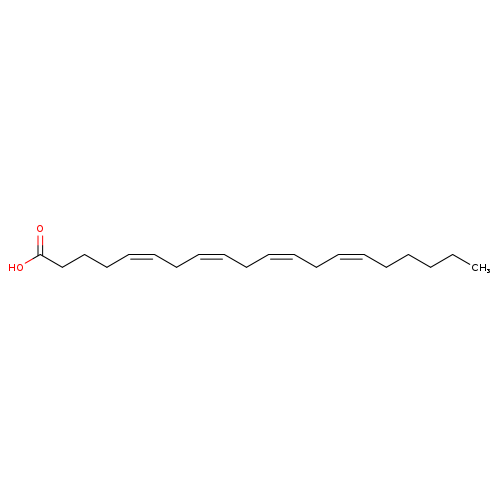
Arachidonic acid belongs to the fatty acids and conjugates, a subclass of fatty acyls within the organic compounds. This lipid-like molecule has the chemical formula C20H32O2 and an average molecular weight of 304.47 g/mol. Industrially, the compound is utilized as a conditioner and softener.
The substance is released from plastics, specifically polystyrene and polypropylene. It has been recorded in three distinct sources: antennas within electrical and electronic equipment, food contact materials used in food processing and cookware, and indoor air, dust, and atmospheric transport. Exposure to arachidonic acid can occur through oral, inhalation, and touch routes.
At the molecular level, arachidonic acid interacts with five recorded protein targets. It serves as a ligand or inhibitor for Prostaglandin G/H synthase 1 (PTGS1), the 14 kDa fatty acid-binding protein, the bile acid receptor (NR1H4), and the peroxisome proliferator-activated receptor alpha (PPARA), in addition to one other protein.
Belongs to the class of organic compounds known as long-chain fatty acids. These are fatty acids with an aliphatic tail that contains between 13 and 21 carbon atoms.